
Published: 17 November 2026
Last update: 17 November 2026
How to Get Last Year's Numbers Ready for Your Tax Preparer
Marketing & Business Tips

Article summary:
Every January, the same moment hits a lot of salon suite pros and booth renters. Your tax preparer asks for your numbers from last year, and you realize they're scattered across a booking app, a checking account, a card or two, and a stack of cash tips you meant to write down.
The good news: getting last year ready doesn't take a week or an accounting degree. It takes five steps, done in order. Here's how to walk into your tax appointment with clean numbers, and what to hand over so your preparer can do their best work for you.
Step 1: Gather every account your money moved through
Before you sort anything, list every place business money touched last year. For most beauty pros, that's:
Your business checking account (or personal account, if you use one account for everything)
Any credit or debit cards you used for supplies, education, or tools
Cash and tips, which is simplest if you deposit them so they show up on your statement
Then download the monthly statements for January through December of 2026 for each bank and card account. Most banks let you download a full year in a few minutes from their website. Twelve statements per account is your starting pile, and it's the most important thing you'll pull together.
Step 2: Know what actually came in
Your income is everything you earned from services, retail, and tips. Most of it is already on your bank statements, because card and app payouts land there.
Your deposits are after fees. Booking apps take their processing fee before they pay you, so your deposits are a little less than what you charged. That's fine, because your profit comes out the same. Just tell your preparer your numbers are after fees.
Hand over any tax forms you get. A payment app sends a 1099-K if it paid you more than $20,000 across more than 200 transactions in 2026 (source). A business that paid you $2,000 or more sends a 1099-NEC (source). Not getting a form doesn't mean the money isn't taxable.
Deposit your cash. Cash and tips count as income too. Depositing them puts them on your statement with everything else.
Step 3: Sort what went out into categories
Go through your statements and put each business expense into a bucket. Your preparer doesn't need every receipt read aloud. They need totals by category for the year. These are the buckets most beauty pros use:
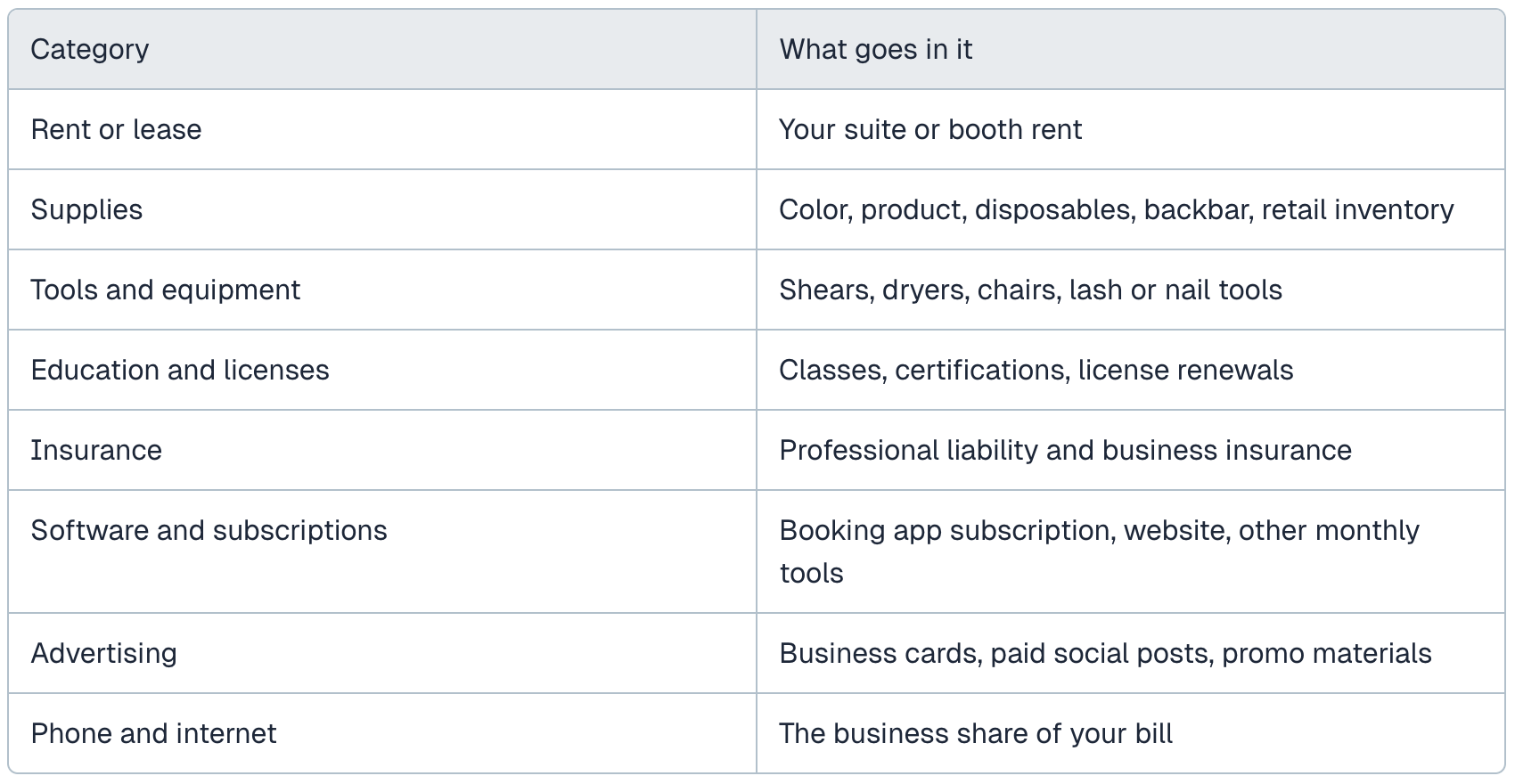
If you drive for work, most solo pros deduct it with the IRS standard mileage rate. Keep a simple log of your business miles (the date, where you went, and why), and your preparer multiplies the total by that year's rate. The rate already covers gas, so you don't deduct gas on top of it. Trips to the supply store or an off-site wedding count. Driving from home to your suite and back usually counts as commuting, so it doesn't.
Step 4: Separate personal from business
If you run everything through one account, this is the step that matters most. Groceries, your kid's soccer fees, and a Target run don't belong on your business return, even if they came out of the same card as your color order.
Mark personal charges as personal and set them aside. Transfers between your own accounts, like moving money from checking to savings, aren't income or expenses either. Counting them can make it look like you earned or spent money you didn't.
Going forward, the single best habit you can build is a separate account and card just for the business, even free ones. When only business money runs through them, your statement is your business: every deposit is income, every charge is an expense, and you can see what you actually kept each month at a glance. You'll still sort expenses into categories, but you'll never have to pick business charges out of personal ones again, and next January goes much faster. If your accounts are mixed this year, that's okay. Sorting them is very doable.
Step 5: Your yearly checklist for your preparer
Print this, or save it on your phone, and check it off before your appointment. It's the same list every year.
Your total income for the year
Expense totals by category from Step 3
Any 1099-K or 1099-NEC forms you received
Dates and amounts of any estimated tax payments you made
Your business mileage total from your log
Receipts for large purchases, like a new chair or dryer, with the date you bought it
Last year's tax return, if you're seeing a new preparer
Not sure whether you should be making estimated tax payments? Since no one withholds tax from your pay, the IRS expects you to pay during the year if you'll owe $1,000 or more in federal tax when you file. If you work full time from your suite, you'll almost always owe that much, so the answer is usually yes. Your preparer typically figures the amounts for you and gives you four payment vouchers, due in April, June, September, and January. The last one for 2026 is due January 15, 2027, so make it, or at least plan it, before your appointment.
Start the new year knowing your numbers
Getting last year sorted is the hard part. Keeping up from here takes a few minutes a month, and it pays off all year, not just at tax time. When you check your numbers monthly, you know what you're actually keeping. You can make real decisions, like when to raise prices, add a service, or buy that new chair. You can set aside the right amount for estimated taxes instead of guessing. And next January, your checklist is already done before your preparer asks.
Want to learn how? Join Samantha Sandbulte, founder of kade, for a free live webinar this January: Booked Solid and Still Broke? Know What You Actually Keep. She has spent more than ten years in accounting working with booth renters and salon suite pros. You'll learn how to read your own numbers, check your month in minutes, set aside the right amount for taxes, and get last year ready for your preparer. Everyone who registers gets the recording.
If you'd rather not sort your statements by hand, kade sorts each bank and card statement you upload in a few minutes, so a whole year of statements becomes tax-ready books in one sitting, with no bank login and no receipt tracking. Your first statement is free, and Sola pros get the annual plan for $79 with code SOLA79.