
Published: 5 February 2018
Last update: 14 November 2025
Diversity, Progress, and Empowerment in the Beauty Industry
Industry Happenings

The month of February is Black History Month, and it got us thinking, “How has the professional beauty industry changed over the past 60+ years for the advancement of black beauty professionals? What kind of evolution has occurred since the Civil Rights Movement, and since iconic individuals like Martin Luther King Jr., Rosa Parks, and Malcolm X had their voices heard? How has this movement and awareness paved the way for the African-American beauty professional?”
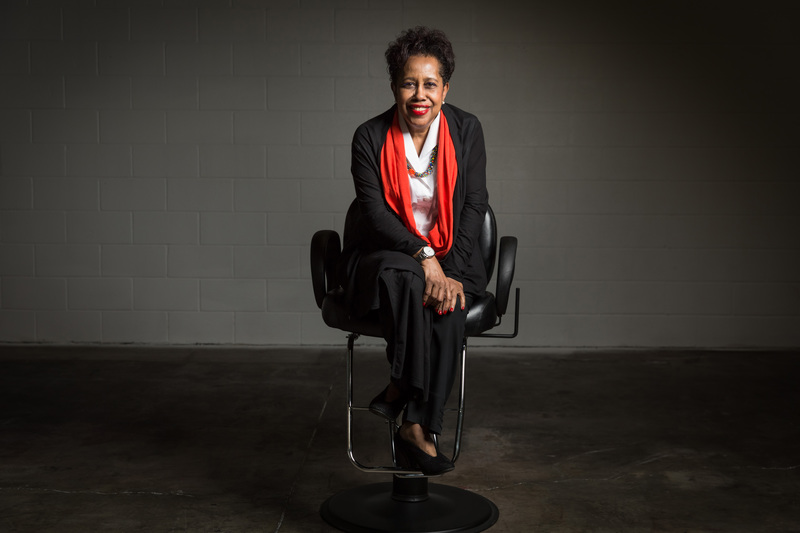
And when we think about Black History Month and hear the name Martin Luther King Jr., Polly Sanders-Peterson, one of our 2018 Faces of Sola, immediately comes to mind. During the March on Washington for Jobs and Freedom on August 28, 1963, Polly opened up her salon and gave free haircuts to white women the day MLK spoke. Leading up to that pivotal point in her career wasn’t all sunshine and rainbows. She faced countless obstacles of racism and segregation while trying to make a living standing behind the chair.
Did this type of racism and segregation exist when Mahogany Plautz, another 2018 Faces of Sola stylist, started her journey into the beauty industry? Her parents married in 1975, not long after mixed-race marriage was legal, and growing up bi-racial and not having a lot of other kids like her around was difficult. “I had to learn some really tough lessons about what that meant to me and how I identified myself,” she shared with us during our interview for the 2018 Faces of Sola photo/video shoot.
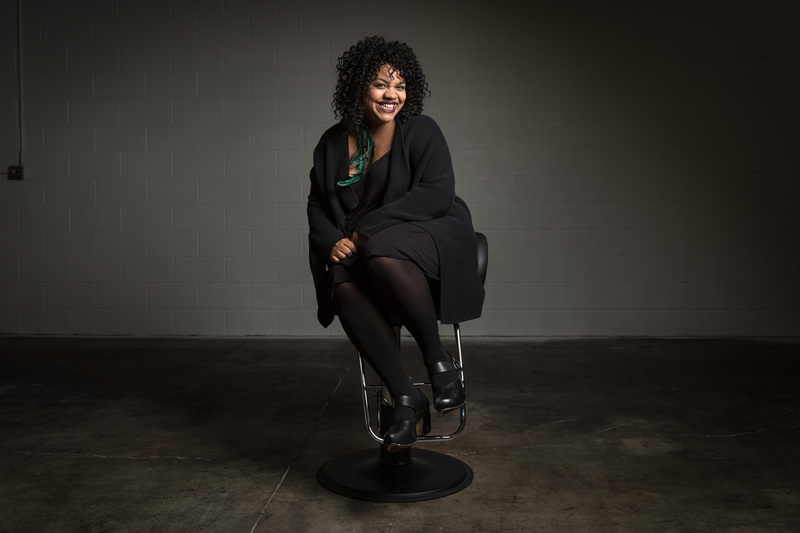
How did Mahogany’s professional journey compare to Polly’s? Where were there parallels and differences? In order to answer these questions and to have a better understanding of their individual journeys, journeys with a 30-year difference, we decided to get up-close-and-personal with them. We asked both of these women the same questions to see how their answers compare, considering their age difference and the number of years they have spent standing behind the chair.
While both women’s journeys are uniquely theirs, there is one overarching similarity between the two: their message is one of empowerment, resilience, and strength.
Let’s dive into their Q&A.
Sola: How many years have you ladies been in the beauty industry?
Polly: 53 years.
Mahogany: I’ve been in the industry for 22 years and have been behind the chair for 17 years.
Sola: In beauty school, were you presented with any challenges due to being a black woman? If so, how and when were you able to overcome them?
Polly: Yes. I actually was the first African-American to attend and graduate from Hollywood Beauty College in Denver, Colorado back in 1963. Upon my arrival and introduction, Harry, the school manager, told everyone not to make any difference with me. So I had to learn white girl's hair, foundation, make-up, etc.
Also, a customer of the college said to my face that she didn't want a colored woman to do her hair. Harry intervened and said, “You don't want her, well then you can't have no one else do your hair here!"
He taught me not to let this determine my worth! This paved the way for all the rejections to come in the all white salons that I was to work in!
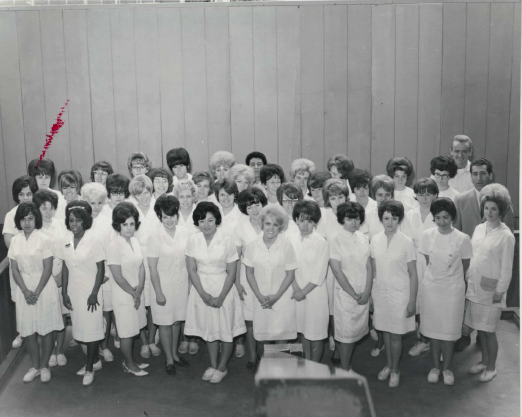
Mahogany: For me, there were more opportunities than challenges. I had little experience with kinky curly hair that wasn’t my own when I started school. However, myself and the other black students were given mostly, if not only, black guests. There was little to no time spent learning the care and styling techniques needed to understand the needs of our black guests. That’s where the other black students stepped in. I learned so much from my classmates! I will be forever grateful to them.
Sola: After graduating cosmetology school, did you face any career obstacles, job placement, and/or career opportunities or advancement due to being a black woman?
Polly: I had a hard time getting hired as a hairdresser in salons, but one day, a lady named Minnie hired me. But soon after that, I had to find a new salon because Minnie’s was too far from my home, and I had no car.
The second salon I worked at was closer to my home. When I went into the salon, the owner looked at me and said she didn't need help, even though there was a Help Wanted ad in the paper.
There was a girl who worked there who said to the owner, “Remember, I’m going down to part-time and you will need someone.” I was like, “Wow! This just got me in the door!” After the girl said that, she asked me if I could do white hair? I said, “Yes! I went to an all white beauty college!"
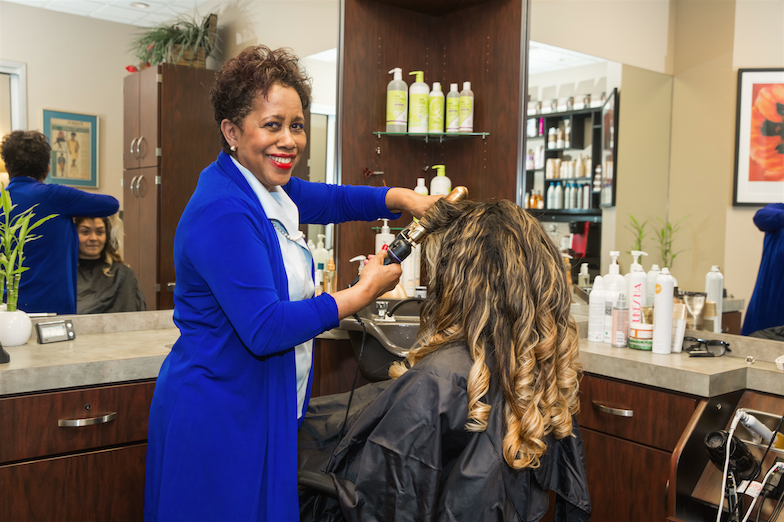
I flourished there and decided to move to a bigger salon that I had seen along the way home when I rode on the bus. I stopped by and met the owner who instantly loved me and hired me. He trained me and instilled in me the best customer service, and even opened the doors for my leadership in the industry. His name was Earl, whom I loved and learned so much from. But in my heart, I was trying to get to Cherry Creek, and no one was hiring blacks at that time. I met this guy named Phil who said he would hire me when his salon opened. Phil opened up the now legendary Antoine Du Chez salon. Talk about open door! I got the job and trained with Michael Taylor. I got a partnership andwent to France with the US Team as an assistant with Michael Taylor. I then became the president of the Denver State Hairdresser Association. Thanks to Phil Sanchez, the Founder of Antoine Du Chez,I learned how to do black hair from a white guy, Michael Taylor! I became the most diverse hairdresser in Denver. I was doing 65% Anglo and 35% black and multi-cultural hair.
Mahogany: I came out of school knowing I had a job working at the salon I was a receptionist for. Very lucky! I assisted the owner and I learned how to build a clientele from referrals. I had all the right knowledge to go far. Over the years I have had a great many people who have voiced their concern about my ability to understand “white” hair. The truth is, hair is hair and the color of the human sitting in my chair does not dictate how you do their hair. Understanding texture and what each texture needs are the sign of a true professional.
Sola: Have you ever felt vulnerable in this industry for being a black woman and/or a black hairdresser? If so, do you still feel this way or have you been able to eliminate that feeling?
Polly: After many years of being questioned if I can I cut Anglo hair, or do Anglo hair, the experience has helped me to have confidence. When a new, non-black client sits in my chair and says, “How can you tell if this color or highlight is ready?” I say with confidence, “From performing many hair services!” Yes, it still happens, but infrequently.
Mahogany: Vulnerability is how you connect with other people, so absolutely I have. One thing that has been a challenge for me is the cultural appropriation conversation. Many styles have roots in so many different cultures that people will argue that locs, braids, Mohawks, and head wraps belong to everyone. If only the world was that easy. As a black hairdresser, I have had to explain why looks for fashion shows and editorial looks may be appropriative and have been met with unease. It is hard to explain because there is not an absolute answer. You just know it when you see it. Understanding that the looks themselves may belong to many, but the criticism and downright bigoted judgment people of color face when wearing the same styles their fellow white humans wear and are celebrated for cuts away at people’s livelihoods.
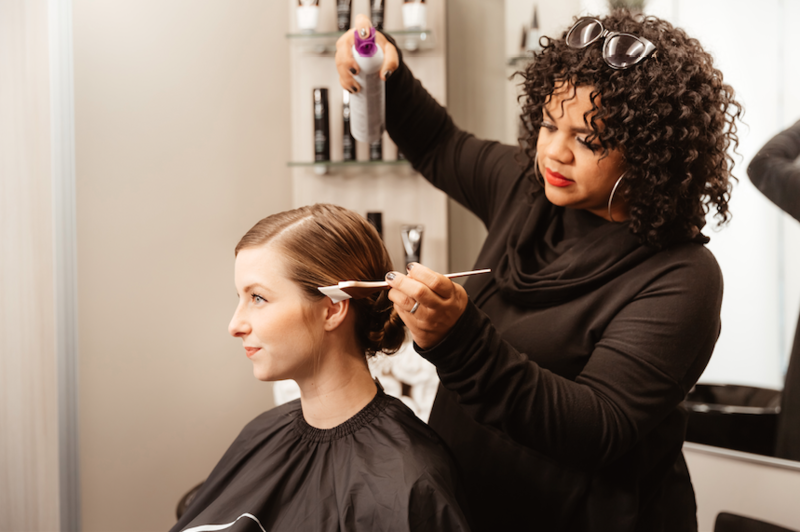
Sola: How has the industry changed and given new opportunities to black stylists?
Polly: The doors are completely open today! In all areas of work, teaching, ownership, training, and income!
Mahogany: To quote Aretha Franklin and Annie Lennox, “Sisters are doing it for themselves!” Even in school, I saw the hustle young black women had with their talents. Earning money and doing it on their terms was a huge focus. Madame CJ Walker was the first black female millionaire and she was in the beauty industry. When I walk the halls of my Sola and see all the different studios filled with black women owning their future and sharing their skills on their terms, it gives me hope and drives me to keep doing me.
Sola: How has the industry changed to meet the hair care needs of black consumers?
Polly: Now we have numerous education opportunities, products, and magazines for the curly hair consumer, and it is a great time for diversity! I just absolutely love it!
Mahogany: Education and community! It is no longer acceptable to say you don’t know how to do “that kind of hair.” Many product companies are beginning to offer education on all hair types. If you are not willing to get the education you need to have that skill, I would suggest doing some research about stylists in your Sola, town, or city who can bridge the gap. Create a referral program with a salon that can.
Sola: How have you personally felt empowered in this industry?
Polly: From my terrific clients, my mentors, the open doors from named leaders, and from earning respect from my colleagues.
Mahogany: My guests empower me every day! I have an incredibly diverse clientele which I’ve curated over the last 17 years to the point where each person makes my day better when they come in. As a Paul Mitchell National Educator, I have also had countless opportunities to hang with stylists who are eager to understand the growing needs of their community. Small towns in the upper Midwest are experiencing racial growth and the stylists are putting themselves out there to learn and grow as stylists. It is one of my greatest joys when I see the light bulb go off over their heads. They realize they are capable of making someone new to their town feel more welcomed and they learn a new skill which will bring them more money. Now that’s living beautifully!
Sola: What are your hopes for black stylists in the professional beauty industry?
Polly: My hope and encouragement are to see other black stylists continue to open new doors in education, product development, and ownership on national and global levels.
Mahogany: Representation! I would love to see more black stylists celebrated for their innovation and talents. As I am writing this, I am realizing that I would like to help bring more eyes to the talents of my fellow black stylists. I want to celebrate them in industry magazines and blogs for the incredible magic they create. Ha! Check back with me on this...I feel an idea forming.
Read: 3 Interesting Facts About Polly
See: Polly's Instagram Feature